S
Slate Magazine
22d
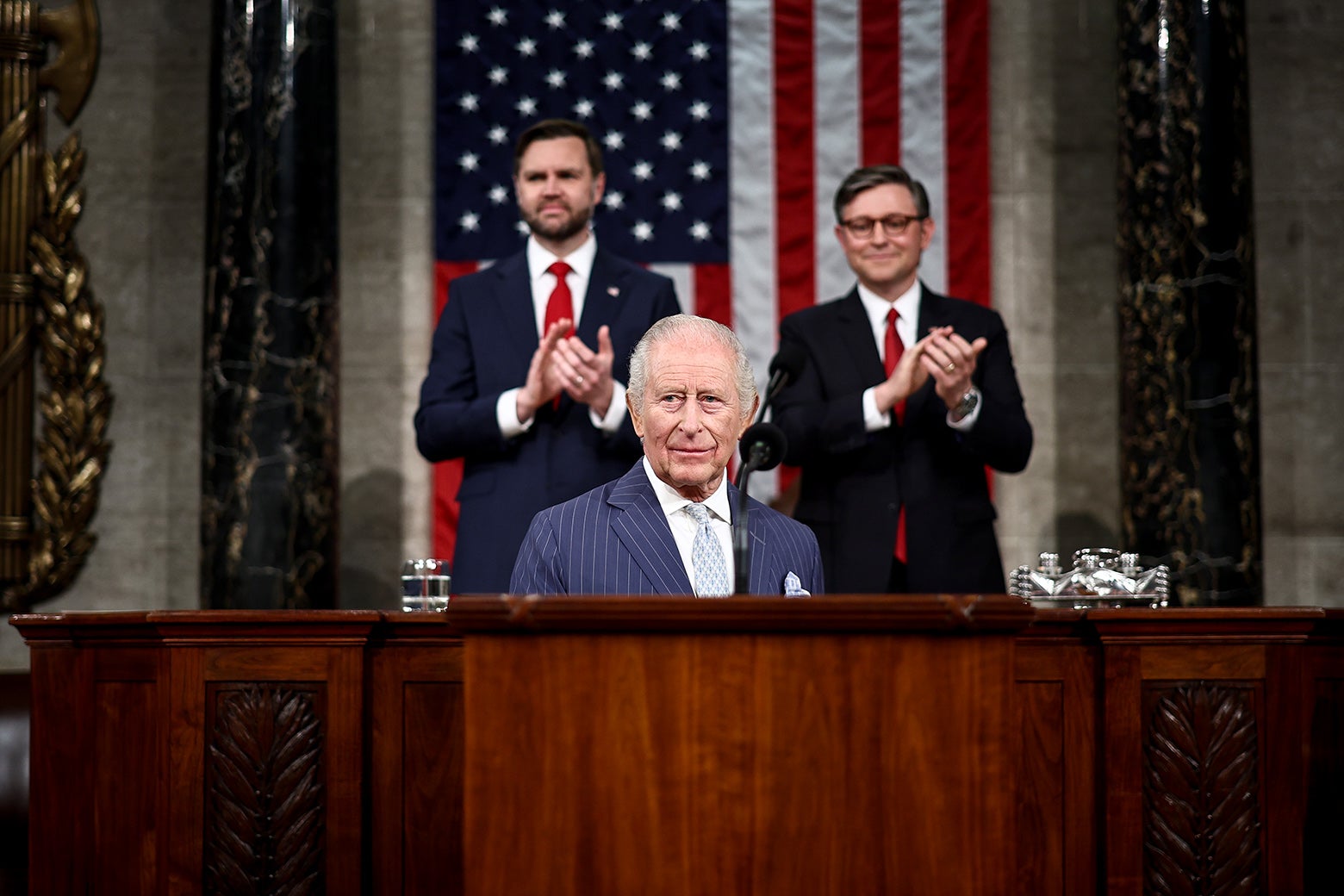
King Charles Addresses U.S. Congress
Sign up for the Slatest to get the most insightful analysis, criticism, and advice out there, delivered to your inbox daily.
America is a divided country. Congress is at a standstill trying to pass key legislation, the military is mired in a conflict in the Middle East, and the president just faced his third assassination attempt in two years. Increasingly everything seems partisan and divisive. Even pop culture feuds and sports rivalries can become markers for political tribalism. But, to celebrate the 250th anniversary of the Declaration of Independence on Tuesday, there was one thing that brought everyone together: the British monarchy.
King Charles III’s address to a joint meeting of Congress was the closest thing in a long time to a kumbaya moment on an ever more dysfunctional Capitol Hill. Members of both parties clapped at most of the same applause lines, laughed at most of the same well-scripted royal jokes, and—on a bipartisan basis—failed to resist the same temptation to use their phones to take photos and video of the visiting royalty.
Even by the standards of past British monarchs in Washington, this was a unifying moment. After all, when Queen Elizabeth II came to Capitol Hill in 1991, two dozen members boycotted mostly in protest of the British presence in Northern Ireland. Three decades later, after the Good Friday Accords were signed and the Troubles largely receded into memory, there were no such objections. After all, sectarian violence increasingly seems more a feature of American life than that in Ulster.
Unlike the State of the Union, the standing ovations were rarely partisan. Sometimes Democrats stood first and more eagerly, like when King Charles III said “executive power is subject to checks and balances” to hoots and hollers from the left. At other moments, Republicans were more eager to stand and applaud, as when he said “the Christian faith is a firm anchor.”
The closest thing to a moment of partisan display was when the British monarch said, “unyielding resolve is needed for the defense of Ukraine and her most courageous people,” and a handful of Republicans refused to stand. In particular, Rep. Lauren Boebert threw her hands up in dismay from her seat in the back corner of the chamber. She had told reporters last week that she wouldn’t meet with King Charles III because: “1776 … I am an American first.” That sentiment did not stop her from attending the speech.
It also helped that the British monarchy retains a certain aura, even after decades of tabloid headlines and Netflix series have tried to drain away the mystique. Shortly before King Charles arrived on Capitol Hill, Statuary Hall was lined with journalists and television cameras waiting for him to walk by. There was an audible buzz when a cluster of people were about to walk through, but then a sense of immediate deflation when it turned out merely to be John Thune or Chuck Schumer. Finally, the British monarch walked through chatting animatedly with Speaker Mike Johnson. There was no noise, no questions (after all, it’s against protocol). There was just the constant shutter of photographs being taken.
The only thing that vaguely approached an act of lèse-majesté against the head of the House of Windsor was the attendance of Mark Collins, the pastor of the First Baptist Church in Yorktown, Texas. Collins came dressed as George Washington, a sideline that he started at Fourth of July celebrations at his church 25 years ago and has continued to this day. But no offense was intended with the Washington costume, Collins explained, noting that he was just there to “honor the King as our special guest.”
Texas Republican Rep. Michael Cloud, who had invited Collins to be his guest, said, “I thought about who to invite for a while. First, I was thinking of who was a big fan of the royals, and then I don’t know, it just hit me. ‘You gotta have George Washington come.’ I called him up, and he was gracious enough to come and be part of us celebrating 250 years as a country.”
The question is quite how uniting the 250th anniversary will actually be in such a fiercely divided country. After all, even Trump’s efforts to expand the White House and build a triumphal arch as a new national monument—measures that would once seem as nonpartisan as the Super Bowl halftime show—have become political footballs. And even the most basic displays of bipartisan comity become newsworthy .
At a time when the legislative branch seems paralyzed and even debates on what it means to be American and what our fundamental civic values are have become increasingly contested, it’s probably not worth celebrating that a few hundred mostly middle-aged Americans managed to applaud at the same time. But still somehow 250 years after the Revolution, the British monarchy somehow avoids these partisan chasms endemic throughout the rest of American society.
Then again, as Cloud said when asked about this irony: “That’s what brought us together originally, right?”
Topic
King Charles Addresses Congress on US 250th Anniversary, Urges Global Engagement
10 posts
→