T
The Intercept
13d
Supreme Court Ruling Eases Racial Gerrymandering
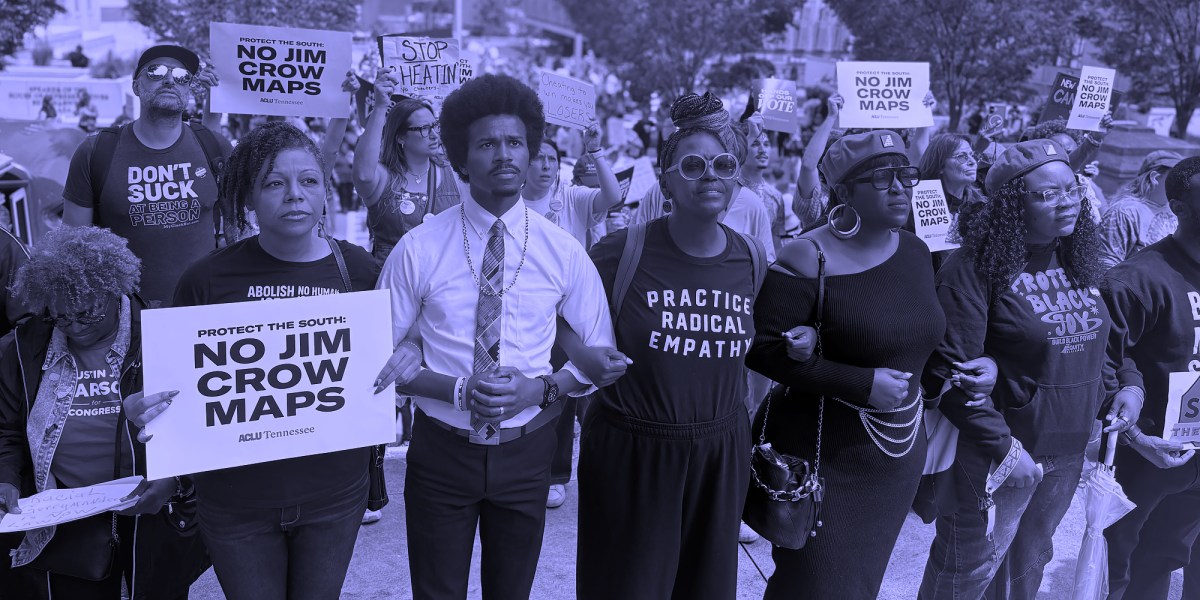
The U.S. Supreme Court dealt a fatal blow to the Voting Rights Act, triggering a new wave of redistricting fights in the midst of midterm primary elections. Last week, the court struck down a Louisiana congressional map with a second majority-Black district. The decision requires there to be evidence of intentional racism to prove that a map is discriminatory, making it nearly impossible to successfully challenge racial gerrymandering.
Following the 6-3 decision along partisan lines, Louisiana suspended its already active congressional primary, throwing out cast ballots. Alabama’s Republican governor took steps to gerrymander her state’s maps ahead of November elections. Tennessee GOP leaders also convened a special session to eliminate the last remaining Democratic stronghold in the state, home to Memphis, a majority-Black city and district; the new map would split Memphis into three districts and further split Nashville and the surrounding counties into five districts. On Thursday, Tennessee Gov. Lee signed a bill that repealed a state law prohibiting mid-decade redistricting, and the new map was passed by Tennessee Republicans.
“The primary goal of what they’re doing. It is to dilute Black political voting power and representation, and it’s starting at the U.S. congressional level,” state Rep. Justin J. Pearson tells The Intercept Briefing. The Democratic Tennessee state representative for Memphis is running for U.S. Congress in the district at the heart of the state’s re-districting fight. “When you look across the South, the truth is about at least a dozen seats are likely to be taken in this very racist redistricting era that we are in, but it won’t stop there,” Pearson says. “We have over 200 legislative seats in the House and the Senate that are also likely to be eliminated through racist redistricting that is happening.”
Voting rights journalist and author Ari Berman says SCOTUS’s latest blow to voters’ rights is a “power grab.”
This week on the podcast, Berman and Pearson speak to host Jessica Washington about how the latest Supreme Court decision bolsters President Donald Trump and Republicans’ aims to take control of voting in the country.
“This is now the third major decision by the Roberts court gutting the Voting Rights Act,” says Berman. “You can’t understand this latest attack on the Voting Rights Act unless you understand the attacks that came before it, and how this is part of a pattern. … This is part of a larger conservative counterrevolution against the civil rights movement of the 1960s.”
Berman says that this ruling could bring us back to the “dark days” before the Voting Rights Act made the United States a “multiracial democracy.” Now you look at what’s going to happen in these places, in places like Tennessee, in places like Louisiana, Alabama, Mississippi. If they eliminate all of their Black members of Congress, that’s going to make politics a white-only game. If politics is a white-only game, that’s going to mean that white supremacy in some form or another is going to be the dominant politics in those states. It’s already the dominant politics in lots of these states, but it’s going to become much more explicit in terms of how it’s expressed.”
Pearson says that the Supreme Court’s assertion that these protections are no longer necessary is a lie. “The hatred that hung us on lynching trees did not disappear. It dissipated into institutions of power, into state houses, into governor’s mansions, into the U.S. Senate, into the U.S. House, into the presidency of the United States,” says Pearson. “Everybody has to do more than they are currently doing in this moment in time in order for us to preserve this modicum of a democratic constitutional republic. … Because what is likely to happen is the most significant purging of Black political power and elected Black leaders since the end of Reconstruction.”
“The litmus test for America’s progress is not Massachusetts, New York, and California,” says Pearson. “The litmus test for America’s progress is what happens in the South, where 50 percent of Black African American descendants of enslaved people live.”
For more, listen to the full conversation of The Intercept Briefing on Apple Podcasts, Spotify, YouTube, or wherever you listen.
Jessica Washington: Welcome to the Intercept Briefing. I’m Jessica Washington, politics reporter at The Intercept.
Maia Hibbett: And I’m Maia Hibbett, managing editor of The Intercept.
JW: Midterms are heating up this week, and Maia, on top of being my editor, you also manage our election coverage. So what’s sticking out with you this week?
MH: This was a really weird week because we’re coming off some primaries where the most-watched races in the country were actually a set of state Senate races in Indiana. And that’s weird because most people don’t even know who their state senator is. It’s very rare to be focused on state legislative elections as the top race.
But this one was seen as a huge test for Trump because essentially he was on this revenge path where a handful of Indiana state senators, Republicans, part of his party, had defied the president when he wanted them to redistrict the state. So he said, I’m gonna primary you, and I’m gonna kick you out of office for not doing what I wanted.
In all but one or maybe two of those cases, the people that Trump backed — so the challengers taking out the incumbents — won. So it looks like, if that was a test of Trump’s power in his base, at least in Indiana, at least there, it looks pretty good for him on that front.
JW: Trump has really set off this redistricting war that’s happening across the country. There was this idea that Donald Trump was going to be weakened by the war in Iran, by the economy. The fact that we’re also seeing redistricting, which generally makes people really angry, also doesn’t seem to be weakening Trump, that sets the stage for something really interesting in the midterms.
MH: It’s a really interesting question because I think it gets at the constant tension in politics between the politician’s identity and the issues.
So on the issues, the conventional wisdom right now is that Trump and the Republicans look really weak going into the midterms, right? People don’t love it when you’re running on lowering the cost of living and not starting new wars — and then you start a new war and spike the cost of living.
But it is still, in my view, a cult of personality around Trump in the Republican Party, and it seems like he still holds a ton of sway over what the Republican base thinks. That’s really interesting if we think ahead, not just to the midterms, but to 2028, which unfortunately we’re already thinking about because even if Democrats have a stronger footing perhaps on a lot of these popular issues right now, they don’t have that figurehead.
JW: Republicans have been unleashed by the Supreme Court ruling striking down Louisiana’s congressional map with a second majority-Black district. The ruling also required there to be evidence of intentional racial discrimination to prove that a congressional map is discriminatory.
Obviously, we know that there’s going to be many new redistricting efforts as a result of this ruling, and we’re going to get into the ruling itself a little later in the episode. But Maia, where are we seeing pushes from Republicans to reshape the map?
MH: Right now, this is according to The AP, as of Thursday, there are four states that are still in flux. Louisiana, as you mentioned; there’s also Alabama, South Carolina, and Tennessee.
This is such an interesting issue because gerrymandering to help your party get seats or keep seats is frankly anti-democratic in the simplest, most literal possible sense of the word. You’re taking some of the power of choice away from the people. But it also puts politicians in a really weird bind because if one party’s doing it, how is the other party supposed to not?
JW: Yeah, as you point out, there’s been a lot of news on that front. On Wednesday, Republicans in Tennessee unveiled a new congressional map that would split Memphis into three distinct districts and further split Nashville and the surrounding counties into five districts. The new Memphis district would span nearly 300 miles. On Thursday, the Tennessee House passed this new map.
Then there’s Virginia. The FBI raided the office of Virginia Senate President Pro Tempore Louise Lucas on Wednesday. She’s one of the leaders in the Democratic-led redistricting fight there, and she’s been a real target of Trump and Republicans’ ire.
On the podcast today, we break down the latest Supreme Court decision with voting rights journalist Ari Berman and Justin J. Pearson. He’s a Democratic Tennessee state representative for District 86 in Memphis. He is also running for Congress in the district at the heart of these redistricting fights. Pearson lays out Republican strategy to eliminate the last remaining Democratic district and gut Black voting power in the South.
But first, we’re going to start with Ari. He’s going to give us more of a bird’s-eye view of what this decision actually means for voters and democracy as we head into an election.
MH: Cool. I’m excited to hear that conversation.
JW: Ari, welcome to The Intercept Briefing.
Ari Berman: Hey, Jessica. Great to see you. Thank you.
JW: Glad to have you on. I want to get into the news of last week. As you’re well aware of, last week, the Supreme Court dealt another blow to the Voting Rights Act, striking down Louisiana’s congressional map with a second majority-Black district, and requiring there to be evidence of intentional racial discrimination to prove that a map is discriminatory.
Ari, you wrote that the Louisiana v. Callais decision “narrows Section 2 of the Voting Rights Act to the point of irrelevance, making it nearly impossible to prove that a gerrymandered map violates the right of voters of color.”
What did you mean by that, and what does this decision mean for voters?
AB: What I meant by that is that the last remaining weapon of the Voting Rights Act is essentially gone. The Supreme Court has already narrowed other parts of the Voting Rights Act, or struck them down altogether, so that the law has lost almost all of its teeth. And now they took away the last part of it, which was the protections against racial gerrymandering — the ability of voters of color to elect candidates of choice.
Basically what they said is, those districts in which voters of color can elect their preferred candidates are unconstitutional. At least, that’s what they ruled in Louisiana. The expectation is that’s what they’ll rule in other places as well.
My big fear with this ruling is that it’s going to lead to a major rollback in representation for candidates of color. It could lead to the largest drop in Black representation since the end of Reconstruction. You could have a situation throughout the South — where the largest percentage of Black Americans live — there could ultimately be no Black representatives. That would take us back to the Jim Crow era, in terms of how representation looks in America.
“You could have a situation throughout the South — where the largest percentage of Black Americans live — there could ultimately be no Black representatives.”
“You could have a situation throughout the South — where the largest percentage of Black Americans live — there could ultimately be no Black representatives.”
JW: You’re laying out a really scary scenario where we no longer have any of the protections that the Voting Rights Act — that was obviously so hard-won and fought for — those protections are now mostly gone. I guess my question is, for voters as they’re thinking about primaries, November, what does that mean for them?
AB: Voters are going to have less choices. It’s going to mean that red states, in the South in particular, are going to maximize Republican representation. The way they’re going to do that is by eliminating Black representation, because in the South, voting is very racially polarized. By and large, white people vote for Republicans, and Black people vote for Democrats. That was one of the really insidious things that the Supreme Court said in their opinion in Callais was basically that, if Black people support Democrats and Republicans are just targeting Democrats, then it doesn’t matter that Black voters are disenfranchised.
But the fact is that even if race and party are intertwined, this is ultimately about race. This is ultimately about white legislators in all of these states — because all of these Southern states have white-majority legislatures and governors — eliminating Black districts. That means that in a place like Mississippi, for example, that’s 40 percent Black, you could have no Black representatives. In states like Alabama, Louisiana, South Carolina, Tennessee, states with large Black populations, there could be no Black representatives, and that means those communities are going to be underrepresented.
“This is ultimately about white legislators … eliminating Black districts.”
“This is ultimately about white legislators … eliminating Black districts.”
A lot of these communities are already underrepresented in Congress, and a lot of these communities are already among the poorest, most impoverished areas with the greatest need for representation, and now they’re going to have the least amount of representation. It’s really going to skew representation all across America.
JW: You just brought up Louisiana. And in this episode, we also are going to speak to Justin J. Pearson, a Democratic Tennessee state representative for District 86 in Memphis, about how after the Supreme Court ruling last week, Sen. Marsha Blackburn, a Republican from Tennessee, called for eliminating the one remaining Democratic-held House seat, which is home to Memphis, a majority-Black city.
What’s your reaction to that redistricting effort?
AB: It just reminds me of what happened when Reconstruction ended in the South. That you had a situation where there were Black members of Congress from the South elected during Reconstruction after the passage of the 15th Amendment. And then you had violence, you had fraud, and then you had, ultimately, changing of the laws: things like literacy tests and poll taxes and gerrymandered districts and all-white primaries.
Suddenly, there were no more Black representatives, and that situation lasted for nearly 100 years in the South. When I see states rushing to immediately get rid of majority-minority districts, immediately get rid of districts in which there are Black majorities after this ruling, I think of what happened at the end of Reconstruction.
So it’s a very dark chapter in our history. It’s one that we would like to think we’ve moved past. In his opinion in Callais, Justice [Samuel] Alito talked about all the progress that America has made on race, but he completely ignored the dark parts of American history that could return when laws like the Voting Rights Act no longer exist or are functionally irrelevant.
JW: Do you take the court at face value when they argue that racism, racial gerrymandering, these are issues of our past? Should this be understood as more of a conservative power grab, or are these genuinely held opinions that the court is expressing?
AB: It’s impossible for me to get inside Alito’s head and know that, but I think it’s a power grab, ultimately.
The fact that they not only dismantled the Voting Rights Act but did so leaving Southern states time to actually redistrict for 2026 makes me believe that this is ultimately about a power grab. Because at the very least, they could have waited until June when it was too late for most of these Southern states to be able to redistrict.
Instead, they did it with just enough time for Southern states to redraw their maps. The Supreme Court has said over and over, you shouldn’t change voting laws too close to an election. And now they’ve basically allowed all of these Southern states to change their voting laws in the middle of an election — in some cases, canceling elections to put in place new maps.
This is extremely political to me. It’s extremely partisan. This decision just underscores how partisan, how political, how authoritarian the Roberts court has become.
“The Supreme Court has said over and over, you shouldn’t change voting laws too close to an election. And now they’ve basically allowed [it].”
“The Supreme Court has said over and over, you shouldn’t change voting laws too close to an election. And now they’ve basically allowed [it].”
JW: In her dissent, Justice Elena Kagan touches on just how big of a decision this actually is, and how the court is trying to hide the extent to which this is going to change what voting looks like in this country.
So I’m going to just read a small piece of her dissent: “Under the Court’s new view of Section 2, a State can, without legal consequence, systematically dilute minority citizens’ voting power. Of course, the majority does not announce today’s holding that way. Its opinion is understated, even antiseptic.”
What do you make of what Kagan wrote there? Is this a fair reading of the decision?
AB: Yes, because Alito basically made it sound like he was just updating the VRA, it was just these technical changes, and what Kagan said was, this was a demolition of the law. And it wasn’t the first demolition of the law; it was part of a pattern. This is now the third major decision by the Roberts court gutting the Voting Rights Act.
In 2013, they ruled that states with a long history of discrimination no longer need to approve their voting changes with the federal government. That was the first blow against the Voting Rights Act.
In 2021, they ruled that it was going to be much harder for voters of color to challenge discriminatory voting laws. That was a second major blow against the Voting Rights Act.
“This is now the third major decision by the Roberts court gutting the Voting Rights Act.”
“This is now the third major decision by the Roberts court gutting the Voting Rights Act.”
Now they have essentially overturned majority-minority districts, which is a third major blow of the Voting Rights Act.
You can’t understand this latest attack on the Voting Rights Act unless you understand the attacks that came before it, and how this is part of a pattern. A pattern that the Court wants to dismiss, but a pattern that is now impossible to ignore.
JW: To your point, the echoes of the Supreme Court’s 2013 Shelby County v. Holder decision are clearly felt throughout both the dissent and the opinion. For those who don’t know, the Shelby County v. Holder decision effectively struck down Section 5 of the Voting Rights Act, which required certain states and localities to seek preclearance before changing their voting laws. Can you set the stage a little bit more for us about what happened in Shelby County v. Holder, and how we’re still feeling that to this day?
AB: Shelby County v. Holder eliminated the most important part of the Voting Rights Act, because the requirement that states with a history of discrimination, largely but not exclusively in the South, had to approve their voting changes with the federal government. That stopped attacks on voting before they even occurred.
It was like stopping a crime before it had been committed. It was such a powerful tool the federal government had to block voting discrimination. It meant that when all of these Southern states had to do new redistricting plans, they had to be approved with the federal government. Now they no longer have to be approved with the federal government, but they can openly discriminate in terms of these maps.
What was clear at the time was that the Shelby County decision was going to open the door to new attacks on the Voting Rights Act, and the court denied this at the time. Chief Justice John Roberts, who wrote
Topic
Supreme Court Strikes Down Louisiana's Race-Based Gerrymandering
34 posts
→